You may have already worked out that I am an AI optimist.
I have more ideas than time. That has been true all my life, and it’s never going to change. What has changed is the distance between an idea and a working version of it.
This is why I’m an AI optimist. It’s not about speed, or an inability to create for myself. It’s the permission to have an idea that can fail cheaply.
Which is why it is a bit disheartening when the richest man on the planet points the same technology at settling an argument.
The King of the Cockwombles has promised that Grok will generate a full-length, historically accurate Odyssey before the end of the year. It is a poem with a cyclops in it. There is a witch who turns men into pigs.
Headlines like that make the job harder for anyone trying to talk about these tools sensibly. If you already think there is nothing redeemable here, you have just been handed your best exhibit by the man with the biggest megaphone. If you think there is, you are now defending an example you would never have chosen.
But it did get me thinking, and not about the Odyssey.
Generating a copy of film from nothing is close to the least interesting thing you can do. Meanwhile there is a group of people who have spent years, unpaid, on films that already exist. They are not trying to prove anything to anyone. They are trying to fix something they love.
Two kinds of second attempt
A fan edit is the cinematic equivalent of a videogame mod. Someone loves a thing, sees a flaw in it, and decides to patch it. No permission, no budget, no deadline. Just an individual with the source material and a very specific idea of what the best possible version would look like.
That is not the same as a games studio going back through its own catalogue, or a director releasing a special edition. Those are second attempts by the people who made the first one. Fan edits are second attempts by the people who had to live with it.
I have watched a lot of films go under the reverse knife. I can think of only one director’s cut I actually prefer to the theatrical release.
Alien is going to come up repeatedly here. Partly because it sits in my trifecta of the greatest films ever made. Partly because nothing in the franchise has bettered it since 1979.
Cameron’s special edition of Aliens ruined Hadley’s Hope by showing me Hadley’s Hope. The whole dread of that film is assembled from things you do not see. A colony that stopped answering. A transmission that stopped mid sentence. Put the attack on screen and it becomes an event that happened, rather than a hole in the story that your imagination has to fill.
The extended cut of Alien restored the cocooned Dallas scene. It should have stayed out. It answers a question the film was better for leaving open, and it does it at exactly the point where the last act needs to be accelerating. The pacing never recovers.
I am one of the apparently rare people who thinks the 1982 theatrical Blade Runner is the best version of Blade Runner. The narration is not a wound. It is the thing that makes it a detective film. Every subsequent pass has taken something out and left the film a little colder and a little less legible than it was before.
I’ll confess there is bias here.
A pivotal film you see in a cinema, at the right age, sets like concrete. The running time, the pacing, the moment the room went quiet, the bits you did not understand and had to carry home. Change any of it later and it registers as damage, whether or not it is an improvement.
I also am aware parts of this article may read as a sustained complaint about Ridley Scott’s judgement. It is not meant as one. The man made a nearly perfect film on his second time out. That is the point. He got it right, under pressure, with people telling him no.
Three kinds of fan edit
Fan edits split into three rough camps, and it is worth separating them before going further.
The first is play. Someone takes a film apart because it is fun to take films apart. Plan 2001 From Outer Space (https://fanedit.org/plan-2001-from-outer-space/) is a re-edit and re-score of 2001, tightened, restructured, and opening on a gag set to Eye of the Tiger. The title alone tells you the spirit of it: the worst film ever made lending its name to the most solemn one. Nobody is claiming this is the definitive 2001. It exists because someone wanted to see what would happen.
The second is restoration. Same tools, entirely different intent. A version of the film existed, it was good, and then it was taken away. The Star Wars Despecialized Editions are years of work reconstructing the 1977 theatrical release from every source available, because the version people grew up with had been quietly withdrawn and replaced by one with a CGI Jabba in it.
Restoration has a right answer. Match the original print.
The third camp is a passion project aimed at making the best possible version of a film they love. Not the film that existed and was lost, but the version that never existed, because the money ran out, or the schedule collapsed, or the studio panicked, or the script was still being written during shooting. There is no print to aim at. There is only a judgement about what the film was reaching for and whether you have got it any closer.
That is where Alien 3 sits.
A film with no driver
Alien 3 went through a remarkable number of screenplays before anything was shot. William Gibson wrote one. Vincent Ward wrote one set on a wooden planet inhabited by monks, which I have never been able to picture working, though I admire the nerve of it. Scripts were commissioned, abandoned, cannibalised and started again.
By the time it went into production the studio had a release date and no finished screenplay. Sets were being built for scenes that had not been written. Pages arrived during shooting. David Fincher, who had never made a feature before, was handed a film that was already moving and heading towards a cliff edge.
He has since disowned it entirely, which is why no director’s cut exists. He is the one director in this article with a genuine grievance, and the only one who has never gone back.
What makes it ache is everything he did afterwards. Seven and Zodiac are about as close to perfect as films get. Thirty years of evidence that the man could have made a great Alien film, and no version of that film exists.
There are two official cuts. The 1992 theatrical release, 109 minutes, studio-shaped. And the Assembly Cut from the 2003 Quadrilogy box set, 138 minutes, put together by a producer working from Fincher’s notes without his involvement. That second one is telling. The nearest thing to an authorised restoration of this film was assembled by someone who was not the director, from paperwork, a decade later. A fan edit with a budget.
Then, in April 2025, after nearly five years of work, a group calling themselves Project A34K released Alien 3: The Legacy Cut (https://linktr.ee/projecta34k).
It runs 143 minutes. It starts from the Assembly Cut and pulls scenes like the dogburster back in from the theatrical version. The Blu-ray was upscaled to 4K. There is a shot-by-shot colour regrade. Music was moved around, some of the creature audio was replaced and pushed louder, and the facehugger was taken out of the opening titles.
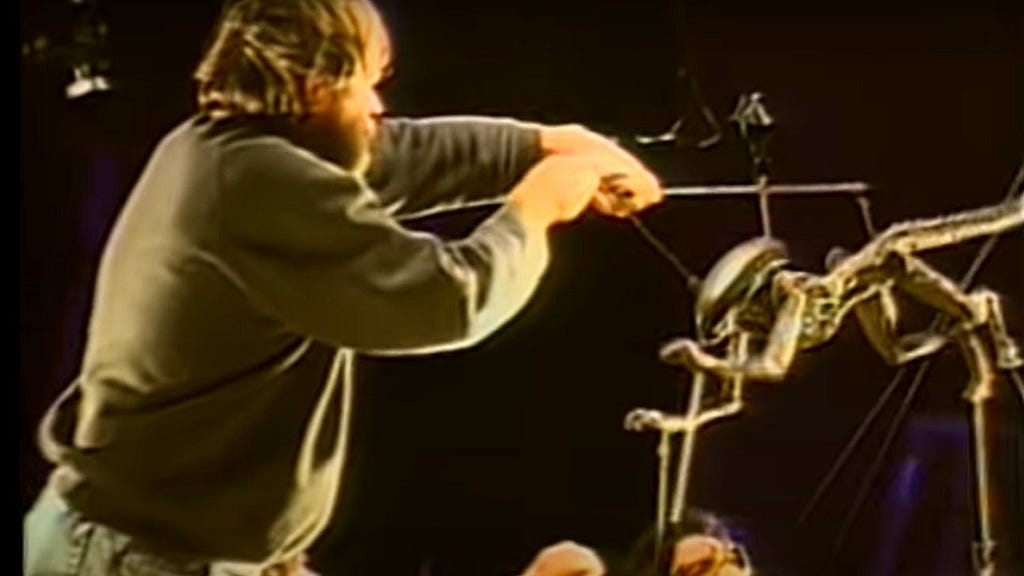
The part everybody talks about is the creature. Alien 3’s effects have always been the thing that ejects you from the film, rod puppet composited against plates that never quite sit together. Ambition well beyond what the budget and the schedule could support. The editor’s own diagnosis is precise about it: the colour grade rarely matched the background plate, so the creature sat apart from everything else in frame, and the rushed matte left a jagged edge around it.
A34K’s solution was to break each shot down into individual frames, take them into Photoshop, and trace around the Alien by hand. He started with a mouse. He moved to a Wacom tablet later. Dedicated rotoscoping software was not viable, because the compositing was too messy and the puppet too intricate for it to cope.
He traced a feature film. That alone accounts for a large share of the five years.
It is free. It has never been sold. The team ask only that you own a legal copy of the film. The site could disappear tomorrow. They shipped it with an audio commentary and a long written account of every decision they made and why.
The reception has been close to unanimous. The fan edit community approved it almost immediately. The recurring phrase is ‘shelf replacer’, meaning people are no longer reaching for the official discs. The Legacy Cut is now simply what Alien 3 is.
Five years. Unpaid. Illegal. On a film that most people gave up on in 1992.
Five years with a mouse
Here is the thing that has been nagging at me since I read A34K’s account of his process.
Everything he did by hand is now, in principle, a perfect problem to throw at a model.
Not generation. Repair. You have the original plate. You have the puppet. You have motion that already exists and a depth relationship the camera already recorded. Video-to-video with cleaned start and end frames, depth maps derived from the original footage, motion followed rather than invented.
The creature stays the creature. The performance stays the performance. What changes is the edge, the grade, the seam where two elements were rushed into the same frame in 1991 by people working past their means.
That is not a hypothetical. That is available now. I was tempted to have a go at a shot or two for this article and stopped, mostly because I suspected I would enjoy it too much to stop at a shot or two.
And it feels defensible. The film is not being rewritten. It is being finished.
Then you start to think beyond.
AI tools don’t have to stop at cleanup. There are models now that will reframe a shot, extend the set beyond where the lighting rig ended, generate coverage from an angle nobody shot. Give it another year and a fan edit could contain scenes that were scripted and never filmed. Give it another and it could contain a different actor.
At what point does a fan edit stop being a fan edit.
It brings the possibility that a small number of broken films get saved by the people who love them most. Not remade. Saved. A version of Alien 3 where nothing throws you out of it, assembled by someone who has watched it four hundred times and knows precisely which eleven seconds are doing the damage.
That is a genuinely appealing idea, and yes I am aware that it is also the exact argument George Lucas would make.
What the community thinks, which I should probably have checked first
There is a thread on fanedit.org about the use of AI in edits. It was active this week. I went looking for a finished example to put in this article. I did not find one.
The prevailing view is not squeamish and it is not reflexively anti-technology. It is definitional.
One editor made the case better than I have managed to. On his Mandalorian edit he wanted the character to leave Grogu behind on the farm planet, a thing that does not happen in the show. So he cropped shots, took footage from elsewhere in the series, and cut conversations together until the departure played naturally. His argument is that if he could have simply generated that scene, the skill would have moved out of his editing and into a prompt. It would be a good scene. It would not be a fan edit.
The craft is the constraint. That is not a romantic position, it is an accurate one.
It’s worth being precise about where the line actually falls though, because it is not where an outsider would guess. Upscaling is fine. Stabilisation, frame interpolation, Topaz, all fine, all in use for years. Ebsynth gets used for effects work. Voice models get used to loop dialogue that was never recorded. Nobody is arguing about any of it.
The objection is not to AI. It is to generation.
And the evidence of how seriously they take it is that after several years of these tools being freely available, the acclaimed edits still contain no generated footage. Nobody enforced that. There is no rights holder policing it and no money at stake. A group of people already breaking copyright for fun arrived at a restriction and kept to it.
I suspect that will soften. Not collapse, soften. There is a category the current line handles badly, and it is exactly the one A34K spent five years in: a shot where every element is already on the film and the only problem is that two of them were rushed into the same frame in 1991. Nothing needs inventing. The plate is there.
Used carefully, on the small number of problems that genuinely cannot be solved any other way, I think it makes the form better rather than dissolving it.
The most radical edit in the franchise generates nothing
I’m about to watch Alien: Paradise.
It is a fan edit by Job Willins that takes Prometheus and Alien: Covenant and interleaves them into a single two and a half hour film centred on David. It’s not an abridged double bill. The two stories run in parallel and play off each other, which turns the creator and creation theme into the spine rather than something the dialogue keeps announcing. It uses deleted scenes and material that only ever appeared in marketing. Some music has been changed. A small amount of additional audio was recorded.
Honestly, I’ll be amazed if it works. For me these two films committed a fairly comprehensive list of war crimes against a universe I have loved since I was too young to be watching it.
But it’s telling what it does not contain. Not a generated frame. The most structurally radical thing anyone has done to this franchise was achieved by rearranging footage that already existed until it meant something different. One person, two films, and a better idea about what order they should happen in.
Which is the part I keep arriving back at. Every argument I have had with myself in this article has been about what these tools can add, and the best answer anyone has produced was reached by taking things away.
The five years A34K spent tracing a puppet were not the achievement. The achievement was knowing which eleven seconds were doing the damage. That judgement is the entire art form, and no amount of compute supplies it. If a model can eventually take the tracing off a fan editor’s hands, good. It buys them five years to spend on the only part that was ever difficult.
The alternative is a man with more money than anyone alive, promising to conjure a feature film out of nothing by December to win an argument about a poem.
Not to fix anything. Not to finish anything. To be right.
The views expressed in this article are my own and do not represent the views of my employer.