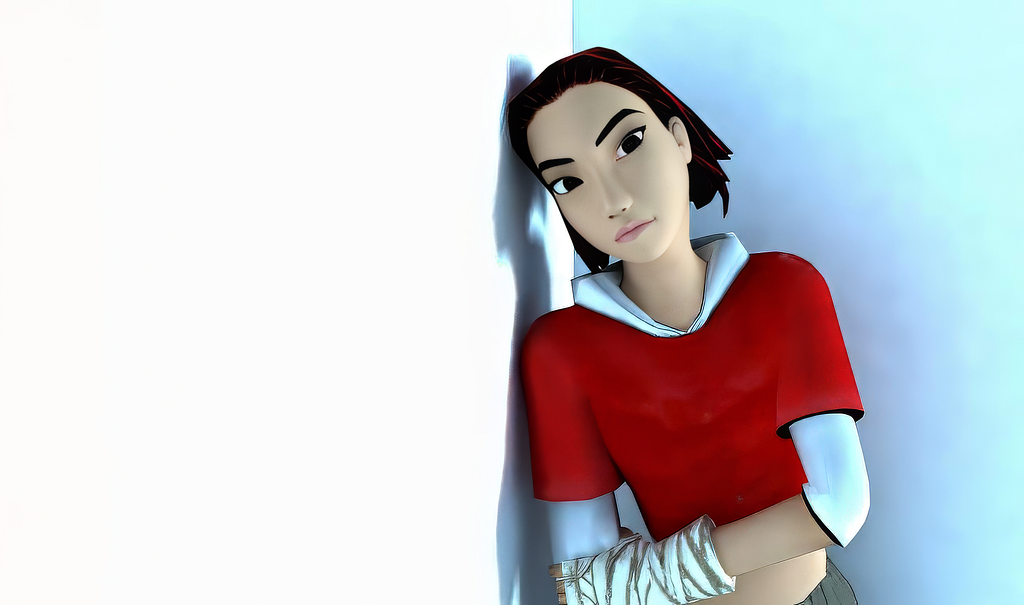
About twenty-five years ago I led a game called Orchid at Argonaut. It was an original Xbox title, a third-person brawler with a cel-shaded, comic-book look, and it followed Croc and Croc 2. It was cancelled in 2003.
That part isn’t unusual. Anyone who has been in games long enough has a project or two that never made it out.
The unusual part is what came after, which was nothing. Orchid only ever ran on Xbox debug development kits. When the kits went, the game went with them. For a quarter of a century, the person who led it couldn’t play it.
I’ve finally fixed that, and I recorded the whole process. This is the preface. The video is below.
The emulator
The first goal was modest. Get Orchid booting on an Xbox emulator, using Claude Code to work through the problems of running a debug kit build on something that isn’t a debug kit.
It worked. After twenty-five years, Orchid was on my screen.
It looked nothing like the game I remembered. The lighting was wrong, everything felt off, and it played terribly. I’m not sure what I expected that moment to feel like, but it wasn’t that.
The recomp
The obvious assumption was that the emulator was to blame. So the next step was to take it out of the equation and build Orchid as a native Mac application.
There was no source code and there were no assets. Everything came from the Xbox ISO images, the shipped binaries and whatever data was on the disc. Claude Code did the heavy lifting of turning that into something that runs natively on a Mac, which is a sentence I wouldn’t have believed a few years ago.
When it first came up, the lighting was still wrong.
That was the real turning point. If the problem survived the move off the emulator, the emulator was never the problem. It was somewhere I hadn’t looked yet.
The lighting
There’s no tidy moment of discovery here. What fixed it was constant experimentation. Change something, run it, look at it, change something else. Over and over, until it looked like the game I remembered.
That last part is worth a second. There was nothing to diff against. No source, no original assets, no known-good build. The target was my memory of how Orchid looked in 2003, which is not the most reliable spec anyone has ever worked from.
The video
The video covers the whole journey: getting it running, the disappointment, the recomp, the long argument with the lighting, what I discovered along the way and what I took from it. It isn’t a polished documentary. It’s me, the builds, and a fair amount of talking.
Booting isn’t the same as coming back
Conversations about preservation tend to stop at “it boots”. For Orchid, booting was the easy part and by some distance the least satisfying. What mattered was getting it to look like itself again.
The code survived on the disc. Knowing what it was meant to look like survived mostly in the people who made it. That’s worth remembering about every lost game that’s still out there waiting: the binaries are only half the archive.
The views expressed in this article are my own and do not represent the views of my employer.