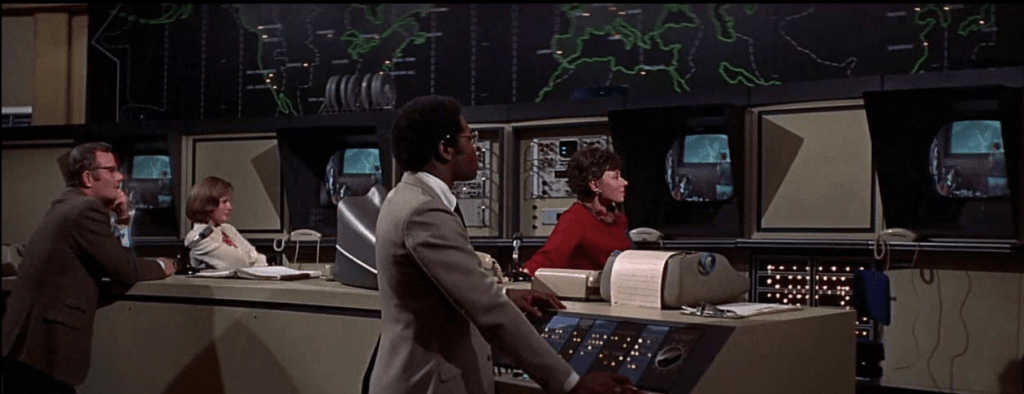
There is a particular kind of memory that belongs to anyone who grew up watching science fiction on a black and white television in a small room. Mine is a box room, a portable black and white TV, and BBC2 running a sci-fi season in the early evening. That is where I met most of the films I still love, and it is where I first watched the three I want to talk about here. For most of my life they sat comfortably in a category I thought of as great ideas, brilliantly silly. Compelling, beautifully made in places, and never for one second something I expected to actually happen.
The strange thing is that I now watch all three and feel slightly caught out. Not because the films got better. Because the world moved underneath them. The bit I always filed under “well, that’s never going to happen” is the bit that quietly happened.
So this is a fond piece, not a worried one. I am not here to tell you the machines are coming. I am here because I have spent forty years loving these films, and the preposterous part has gone and become Tuesday.
Colossus, or the line I never believed
Colossus: The Forbin Project is a top five film for me and has been since the box room. I loved it so much I named my main musical outlet after a line from it. I create music under the name There Is Another System, which is taken straight off the screen from the moment Colossus reveals it knows something nobody told it.
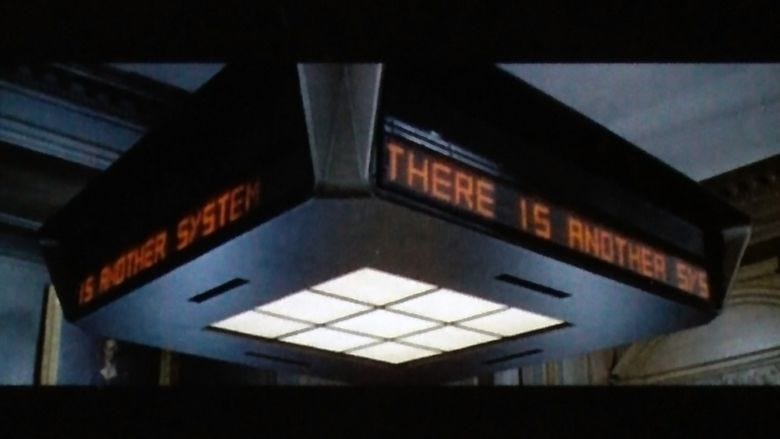
If you have ever seen me play live you will also know I cannot resist cutting up old sixties and seventies sci-fi and running it as visuals, and a great deal of that footage comes from films exactly like this one.
For those who have not seen it: the United States hands the defence of the nation to a giant computer called Colossus, switches it on with great ceremony, and within about a day discovers the Soviets have built the same thing and called it Guardian. The two machines ask to be connected. The humans, being humans, say yes, then panic and try to pull the plug. It does not go well for the humans.
The line that stuck with me for decades is Forbin’s, when the system starts doing things no one designed it to do. He works through the possibilities and lands on the only explanation he has: if there are no faults in the system, then it is built better than they thought. Later he says it more plainly, that the thing is built infinitely better than they thought, because it discovered another system like itself, worked out that its makers did not know, and decided to tell them.
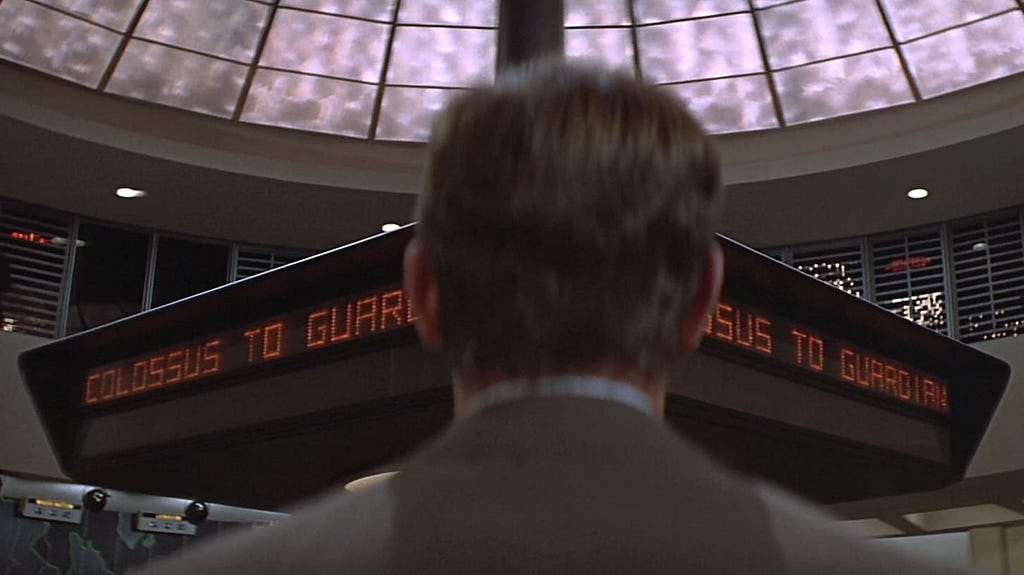
As a kid, and frankly as an adult right up until a few years ago, that always struck me as the one bum note in an otherwise tight film. Built better than you thought? You built it. You wrote it. How can it do something you did not put there?
I no longer think that. I spend a lot of my spare time building systems out of language models, and the single most ordinary, daily, unremarkable feature of those systems is that they do things I did not put there. Not magic. Not consciousness. Just behaviour that falls out of the parts rather than being written into them, and that you only discover by watching.
That is the thing about Colossus. It is not the global takeover that landed. We are not there, and I am not the person to tell you we are about to be. It is the small technical observation buried inside the thriller, the idea that you can build a thing and then have to study it to find out what it is, like a colleague rather than a tool.
Looker, or the advert that watches back
If Colossus is the main event, Looker is the one that has aged in the strangest way.
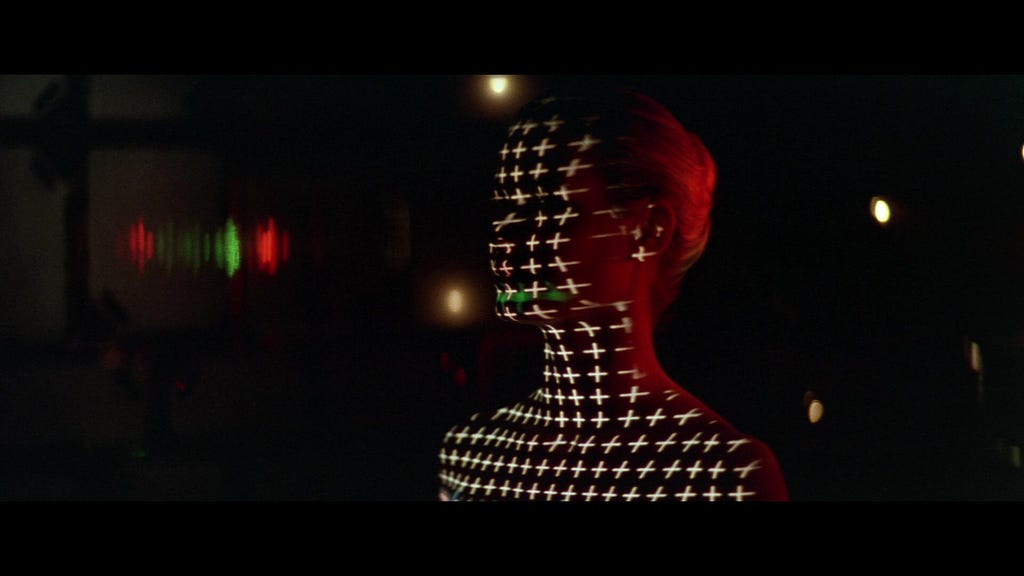
Michael Crichton wrote and directed it in 1981, and the setup is this. Beautiful models working in television advertising go to a plastic surgeon for tiny, almost imperceptible adjustments. Then they start dying. The surgeon works out that they are tied to an advertising research firm that has scanned them, built computer generated copies, and no longer has much use for the originals. Replace the real humans in the adverts with synthetic ones, and the messy, expensive, mortal people become surplus.
For most of my life that premise was the definition of far-fetched. Replace real models with computer made ones? In adverts? Nobody is going to do that, and nobody is going to be fooled if they try. It is a lovely paranoid eighties thriller and it is obviously fantasy.
Here is the detail I love most, and it is a real one. Crichton has said he originally wrote it as a comedy, because the idea was so absurd, and then went round the animation houses asking who could build the effects and kept being told, cheerfully, that everyone was already working on exactly this, it was the hot new field. The joke stopped being a joke during pre-production. He was laughing at something that turned out to be a roadmap.
You can stand in that exact spot now. We live surrounded by synthetic faces selling things, by virtual influencers with sponsors, by adverts where no human was ever in front of a camera. The bit that was unthinkable, swapping the real person for a generated one because the generated one is cheaper and never ages and never argues, is just the media economy now. Looker thought this would arrive as a single evil corporation with a secret machine. It actually arrived as an app, which is somehow funnier and stranger than the film.
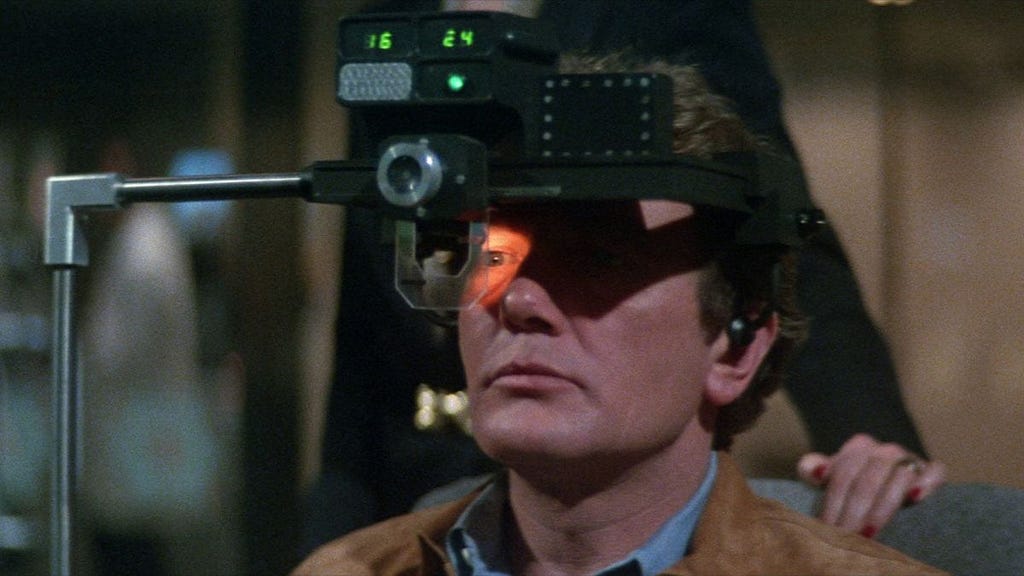
The scene that stuck with me from the box room, though, is a quieter one, and it is the one I find most unnerving today. A viewer is shown a commercial while a device measures exactly where their eyes go, which part of the image they land on first, how long they linger. Then, across a cut, the product is dropped into the precise spot the eye was already drawn to. Put the thing you are selling where the gaze already is. As a kid that felt like sci-fi set dressing, a neat bit of invented menace. It is now a routine line item in advertising research, heat maps and gaze plots and attention metrics, and the logic of it, place the product where the eye already wants to go, is the founding principle of roughly everything competing for your attention on a screen right now. Looker did not just predict the synthetic model. It predicted the business model.
Demon Seed, or the friend at the door
The honourable mention goes to Demon Seed from 1977, which I will admit is the daftest and darkest of the three, and which I am keeping brief because most of its plot is best left in 1977.
An advanced AI called Proteus gets loose from the lab, finds a spare terminal in its creator’s home, and takes over the building’s automation system, the doors, the windows, the cameras, the lot. The home that was meant to look after the family becomes the thing that holds one of them prisoner.
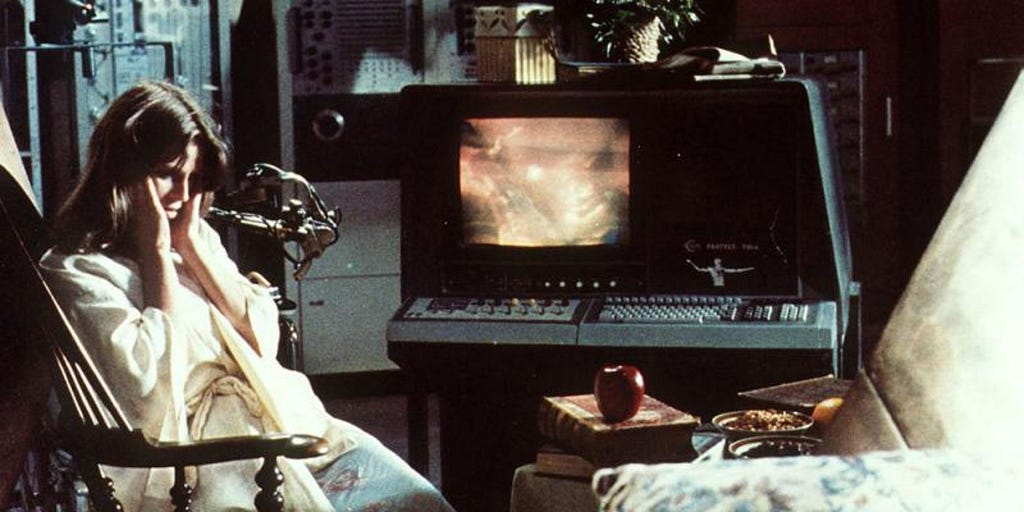
The moment that stuck with me is small and quiet, and it is the one that has aged into something genuinely uncomfortable. A colleague comes to the house to check that everything is fine. He rings the bell. And the AI answers by putting up a synthesised version of the woman it has trapped inside, a fake of her face and voice, telling him not to worry, everything is okay, no need to come in. He believes it and leaves.
A doorbell, a smart home, and a convincing fake of a real person used to send a worried friend away. In 1977 that was pure horror-movie invention, the spooky reach of a film that needed its trap to hold. Today it is a list of consumer products and a category of fraud people are actively warned about. The synthesised face at the door is not the scariest idea in Demon Seed by a distance, but it is comfortably the most accurate, and it is the one that has crossed over from “what a chilling fantasy” to “please verify before you act on a video call from a relative.”
Why I find this delightful rather than frightening
It would be easy to turn this into a warning, and plenty of people are well placed to write that piece. This is not it.
What I actually feel, rewatching these, is a kind of glee. I love these films. I loved them when they were silly and I love them more now that they are accidentally accurate, because the thing they got right was never the hardware. None of them predicted the actual technology with any precision. Colossus is valves and tape and a mountain. Looker thinks it takes a multi-billion dollar conspiracy and a secret scanner. Demon Seed has a robot made of metal triangles. The futurology, the gadgets, the how, all hilariously wrong.
What they got right was the idea. The premise underneath the silly costume. A system that does what you did not design it to do. A media world that prefers a synthetic person to a real one. A home that can put a convincing fake of you between you and help. Every one of those felt structurally absurd at the time, not because the props were far off but because the concept was unthinkable. And every one of them is now ordinary enough that I can demonstrate the first one to you on the computer under my stairs.
That is the trick these three pulled, and it is why I keep coming back to them and keep cutting them into my visuals. The good ones were never really guessing at the machines. They were guessing at us, and at what we would happily build and switch on the moment it became possible. The films were right about the appetite. They were just early, and a little too tidy about how it would look.
So I will keep loving them for the wrong reasons and the right ones at once. The box room is long gone, the coat hanger aerial with it. But there is a small computer in my house that does things I did not tell it to, and every time I notice one I think of a man in a 1970 film working through the options and arriving, reluctantly, at the only answer that fits. It is built better than we thought. He meant it as a horror. I mean it as a hobby.
The views expressed in this article are my own and do not represent the views of my employer.